Proper Quality Management Starts Before the First Cut
At KCSP Machine, quality begins long before a part reaches inspection. It starts the moment a customer sends us an RFQ. Before we commit to a job, our team takes several factors into consideration. We:
Look closely at the requirements
Consider potential risks
Review previous production runs to see if we can improve anything this time around
Determine whether we have the right equipment and tooling to deliver the part as specified
From there, quality remains an integral part of every step until the finished components leave our facility. And if something does go wrong, our quality system provides a structured way to identify and address the issue so we can improve the process in future runs.
Quality Starts During Estimating and Planning
When an RFQ comes through our system, we ask questions:
Have we made this part before?
Did we encounter any issues during previous runs?
Are there opportunities to improve the process?
If it’s a new part, what risks could affect quality?
Do we have the right tooling and equipment?
Can we consistently meet the customer’s specifications?
Are there outside processes or material requirements we need to account for?
This upfront review gives us an opportunity to identify potential problems before production begins. That way, if we see a manufacturing challenge, we can address it with the customer early on rather than discovering it after we’ve already moved the project to the shop floor.
Additionally, this planning helps us determine the right tooling and process strategy we’ll need to run production in an accurate and repeatable manner.
Structured Processes Lead to Smooth Production
Once a job moves into manufacturing, quality requirements continue to guide the process. KCSP Machine operates under our ISO 9001 quality system, while applicable aerospace work is produced under our AS9100 scope.
For each operation, we establish a plan and corresponding inspection requirements. Engineering drawings are properly ballooned, and inspection criteria are documented so our team knows exactly what needs to be verified.
First Article Inspection Creates an Early Checkpoint
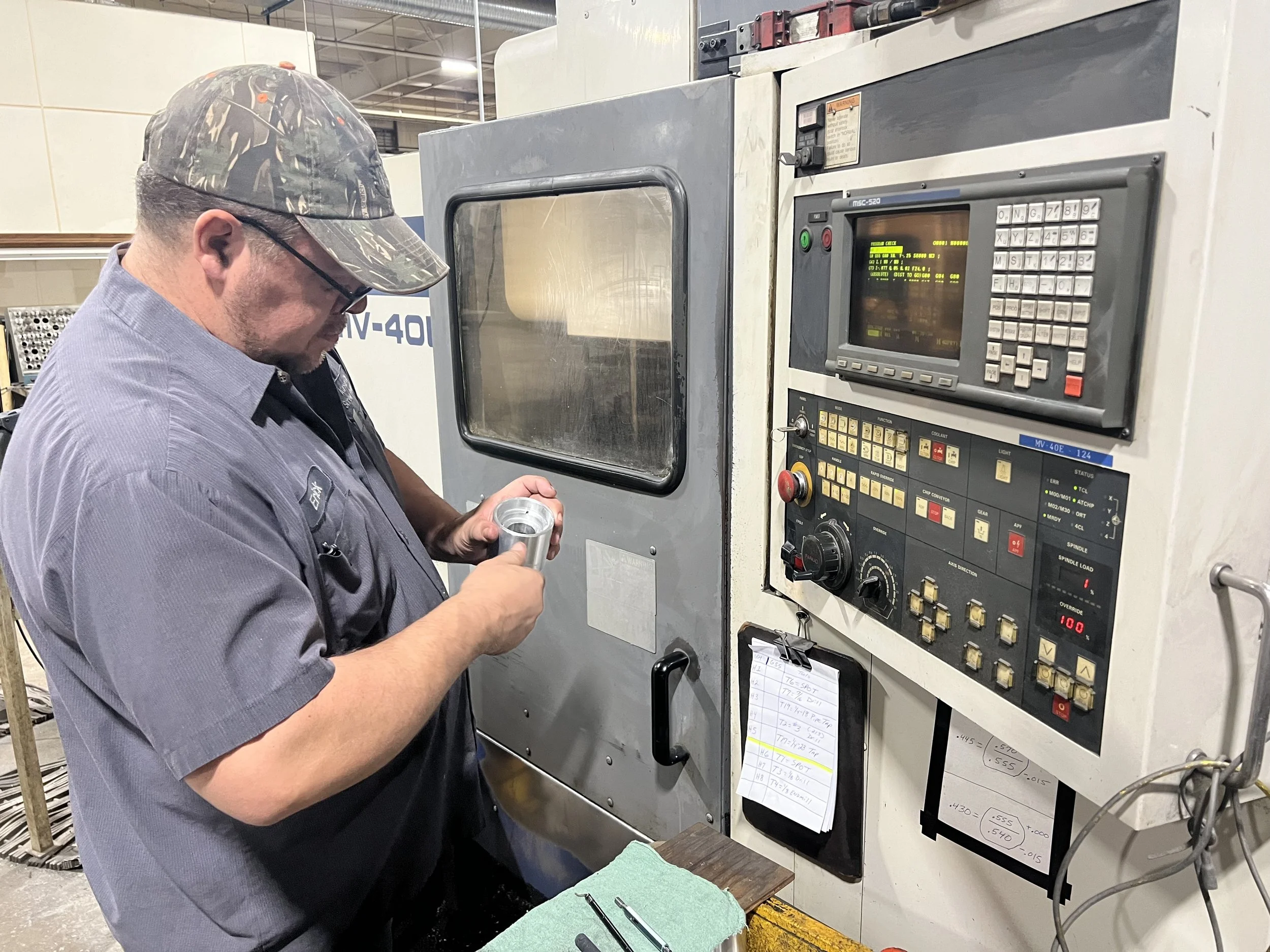
Before production is fully underway, the first article provides an important opportunity to verify the process. Our machinists perform in-process checks throughout production, while the first article inspection is overseen by our Plant Manager, Rob, or delegated to another qualified team member. Final inspection is also performed by someone other than the operator who produced the part.
This second set of eyes is intentional. Our owner, Brandon Worrell, came to KCSP Machine from a tech background, where there’s a common principle: you don’t review your own code! The same idea applies on the shop floor. Having another individual review the work brings a fresh view that can detect blind spots and small mistakes that could go easily unnoticed.
Inspection Continues Throughout Production
Based on the inspection plan, in-process checks are performed during production. These checks help catch potential issues while there is still time to address them rather than waiting until an entire order has been completed.
Our team uses third-party calibrated measuring equipment to verify critical dimensions during inspection.
Final Inspection Verifies the Completed Part
Before an order leaves our facilities, it goes through a final product release process. At this stage, we’re confirming that everything has been handled according to plan, including outside processes and completed inspection reports.
During this stage, we also confirm that our customers receive the documentation required for their parts along with the shipment.
What Happens When Something Goes Wrong?
Even the strongest processes can’t eliminate every potential issue. That’s why we have defined procedures for addressing challenges. This includes handling returns through RMAs, documenting nonconformances through NCRs, and implementing other corrective actions when necessary.
But it doesn’t stop there. Our objective is to understand why issues happened and determine what needs to change so we can prevent them from happening again. When we notice recurring issues, audits and corrective action processes help us investigate the root cause so we can make improvements. From there, we monitor whether those changes are working or if we need to pivot.
What About When a Customer Identifies an Issue?
If a customer identifies a potential quality issue, we work with them to understand what happened, bring the parts back, evaluate the issue, and determine the appropriate corrective action. If we confirm that the issue originated with us, we work diligently to get the customer back on track as quickly as possible and meet their expectations for replacement parts or resolution.
Quality Management Runs Deep
Our ISO 9001 and AS9100 quality systems provide a structured framework for the quality practices happening throughout our business. But the value of our quality systems isn’t just about what’s tied to our certs. The real value is having repeatable processes that help our team make better decisions, document our approaches, identify problems, and continually improve.
At KCSP Machine, quality is part of this conversation, from RFQ to delivery.
Ready to get started on your next project? Request a quote from our expert team!